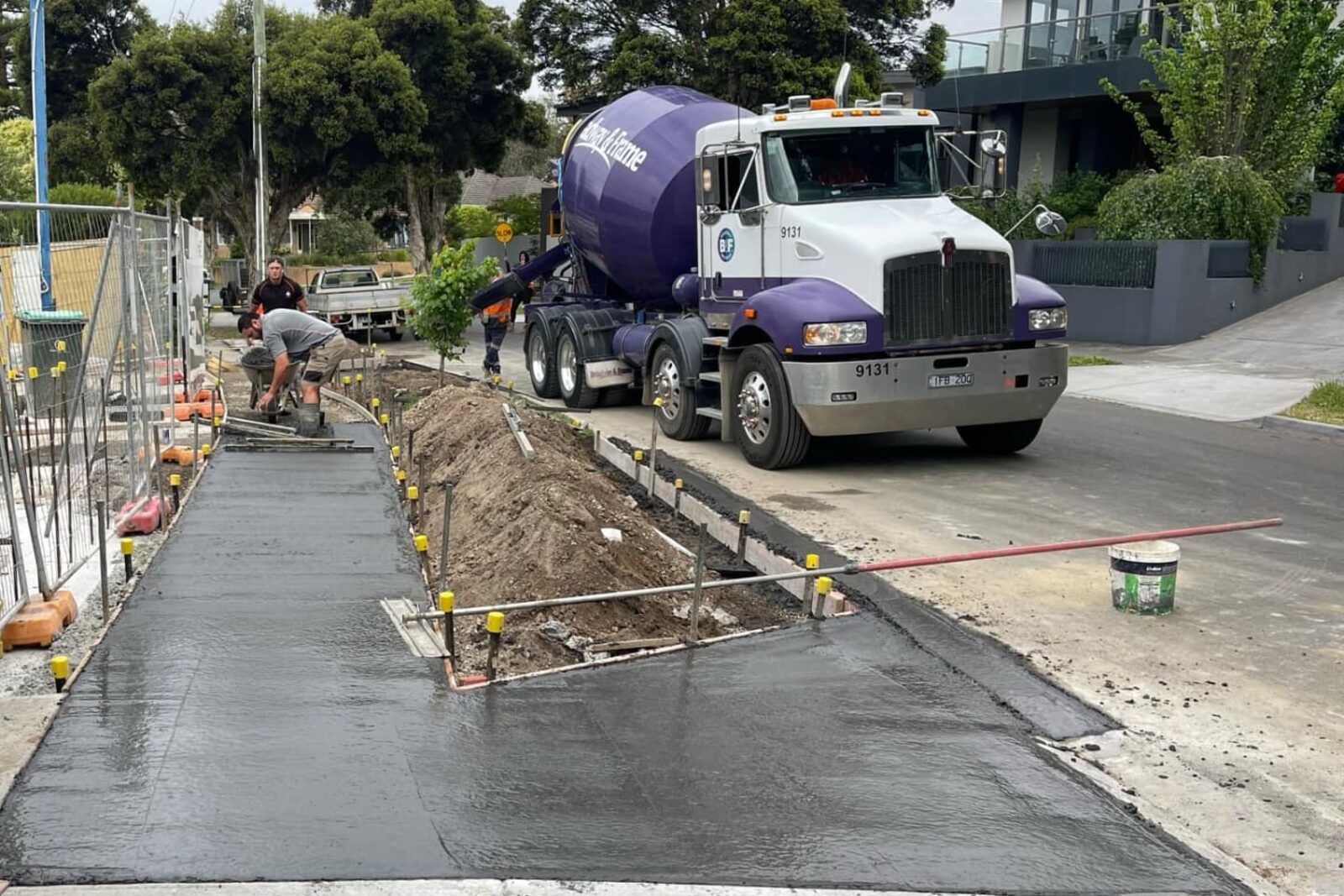
Newly finished concrete slab curing on a Melbourne site

The short version

  • Concrete is usually walk-on hard within a day or so, but keeps gaining strength for weeks.
  • A common rule of thumb is much of its strength by ~28 days.
  • Structural loading timelines follow the engineer, not a fixed number.
  • Good early curing — keeping it moist and protected — makes a big difference.

Once the slab's poured, the waiting begins — and “how long before I can build on it?” is the question every owner asks. Concrete doesn't just dry; it cures, gaining strength through a chemical reaction over time. Here's the difference between set, walk-on and full-strength, and what the timeline really looks like.

Set vs walk-on vs full-strength

Set happens in hours — the concrete firms up and stops being workable. Walk-on hard usually comes within a day or so, enough to move around on carefully. Full strength keeps developing for weeks: as a widely used rule of thumb, concrete reaches much of its design strength by around 28 days, though it continues gaining slowly after that.

When can you actually build on it?

It depends on the load. Some follow-on work can start sooner, but structural loading — walls, heavy materials, vehicles — should follow your engineer's guidance for that specific slab and mix, not a number off the internet. If you're unsure, ask the engineer or builder who specified the slab.

What affects the timeline

  • Weather — cold slows curing; hot, dry or windy conditions can dry it too fast.
  • Mix — strength and any additives change how quickly it develops.
  • Curing care — this is the one you control.

Curing well in the first days

Concrete cures best kept moist and protected early on — covering it, keeping it damp, and shielding it from harsh sun or drying wind in the first days. Rushing to load a slab that hasn't cured properly is how you end up with cracks and weak spots. Patience here pays off for the life of the slab.

Planning a slab pour? Get it placed cleanly and on time — we pump slabs across Melbourne and can supply the concrete. Get a quote →

For the whole slab process from prep to pour, see how to pour a concrete slab.

CGI Concrete Pump Melbourne
Written by CJ Iordanou
Co-owner & pump operator, CGI Concrete Pump Melbourne

CJ is one of the two brothers behind CGI Concrete Pump Melbourne. He's spent 15 years in concrete — on the tools laying it and now running the pumps — so these guides come from real Melbourne job sites, not a textbook.

Connect with CJ Iordanou on LinkedIn
Published 31 July 2026
Concrete Curing & Moisture Control Tips
FAQ

Quick answers

How long until concrete is walk-on hard?
Concrete is usually walkable within a day or so and continues to gain strength for weeks. As a common rule of thumb it reaches much of its strength by around 28 days, though early loading depends on the mix, weather and the engineer's advice.
Can I build on a slab before 28 days?
Often you can start certain work sooner, but structural loading timelines should follow your engineer's guidance rather than a fixed number. Curing well in the first days — keeping it moist and protected — makes a real difference to the end result.
Concrete pump hire FAQ

More questions about concrete pumping

Which parts of Melbourne and Victoria do you cover?
We hire concrete pumps right across metropolitan Melbourne and out into regional Victoria — including the Mornington Peninsula, Geelong, the Yarra Valley and the outer growth corridors. If you're not sure we reach your site, call us on 0412 845 415.
Can you supply the concrete as well as the pump?
Yes. We can arrange ready-mix supply and delivery alongside the pump so you deal with one team for the whole pour. See our concrete delivery page or ask for a combined quote.
How far ahead should I book a concrete pump?
For most residential jobs a few days' notice secures your preferred date; busy periods and larger commercial pours book out further ahead. The sooner you lock in the date the better — get in touch to check availability.
Do I need a line pump or a boom pump?
It depends on access and pour height. Line pumps suit tight residential sites and ground-level work; boom pumps reach over buildings and into hard-to-access areas. Our line pump vs boom pump guide breaks it down, or we can advise on a quick call.
What should I have ready on site before the pour?
Clear access for the truck, a water source for washout, formwork set and signed off, and enough crew to place and finish. We'll walk you through site setup when you book — see our hire rates for what's included.

Fast quotes · Melbourne & Victoria wide

Book a concrete pump that turns up on time

Tell us the site, the pour and the date. We'll come back with a straight price and a clean, reliable pump crew — line pump or boom, resi or commercial.

📍 Based Kilsyth South VIC — serving all of Melbourne & Victoria
✉
GET A QUOTE — 30 SECONDS