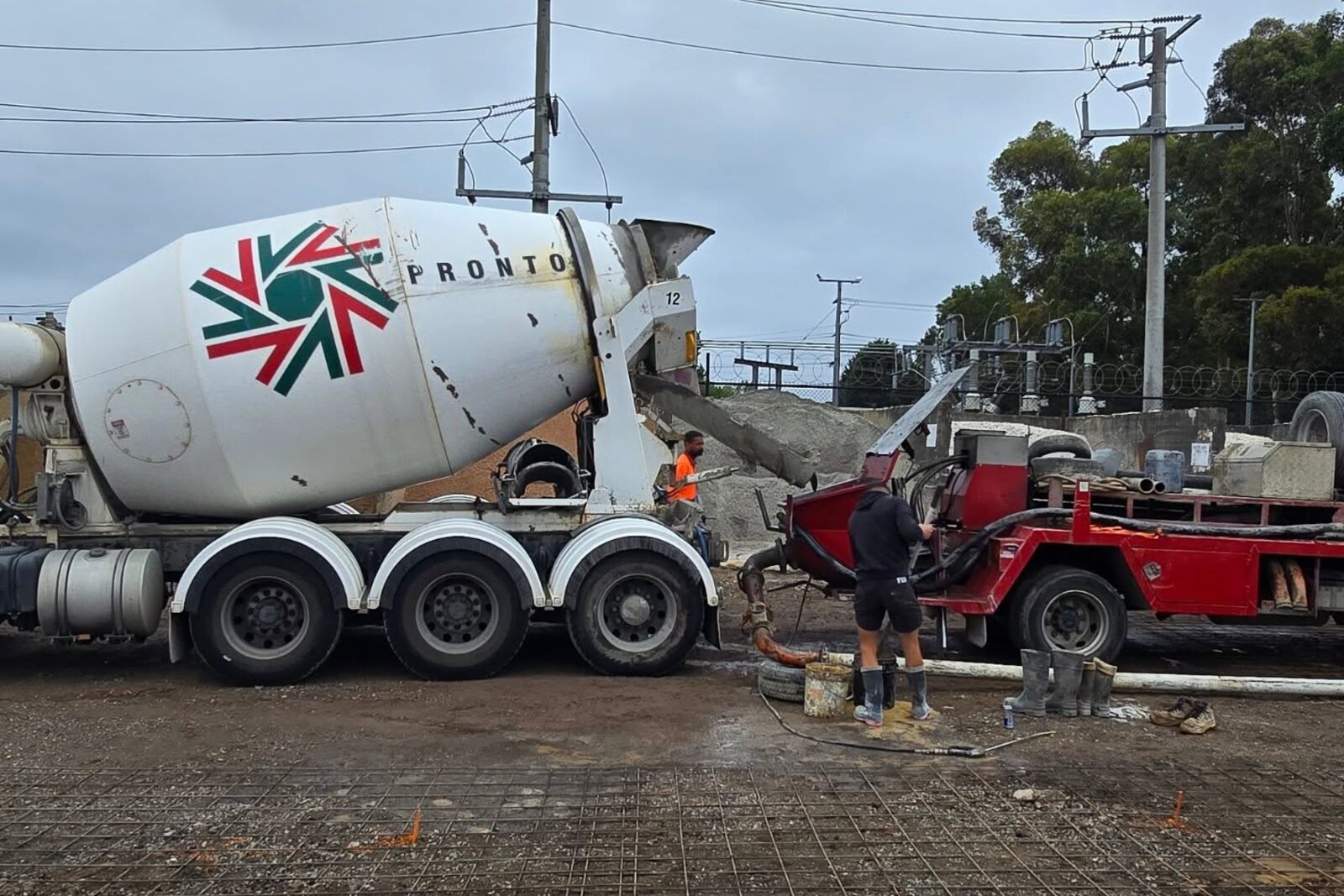
Concrete truck and line pump delivering the volume for a pour

The short version

  • Concrete volume = length × width × depth, in metres, giving cubic metres (m³).
  • For post holes and piers, work out one hole's volume and multiply by the number.
  • Add roughly 5–10% for waste, spillage and uneven ground.
  • Our calculator does all of it for you.

Order too little concrete and you'll be scrambling mid-pour (and risking a weak cold joint); order way too much and you've paid for concrete you have to dispose of. Getting the volume right is the single most useful bit of maths on any job. Here's how to do it.

Slabs, driveways and footings

For anything rectangular, the formula is simple: length × width × depth, all in metres. So a 4 m × 3 m slab at 100 mm (0.1 m) is 4 × 3 × 0.1 = 1.2 m³. Strip footings are the same idea — length × width × depth — just with a narrow width. Keep everything in metres and you'll get cubic metres out.

Post holes and piers

Round holes use the circle area: π × radius² × depth, then multiply by the number of holes. A 300 mm diameter hole 600 mm deep is about 0.042 m³ each — six of them is roughly 0.25 m³. Square piers are side × side × depth. Fiddly by hand, which is exactly why the calculator has dedicated post-hole and pier tabs.

Always add for waste

Real sites aren't perfect — ground is uneven, there's spillage, and forms flex. Add around 5–10% so you're not caught short. Running out partway through a pour is a genuine problem; being slightly over is cheap insurance by comparison.

Let the tool do the maths. The concrete calculator handles slabs, post holes, footings, piers and bagged mix — with a waste allowance built in. Then we can deliver and pump it. Get a quote →

Over or under — which is safer?

Slightly over beats short every time. A short pour can mean a second delivery (and another short-load fee) or a cold joint that weakens the slab. Big over-ordering wastes money and disposal. Aim for accurate plus a small margin — that's what the waste allowance is for.

CGI Concrete Pump Melbourne
Written by CJ Iordanou
Co-owner & pump operator, CGI Concrete Pump Melbourne

CJ is one of the two brothers behind CGI Concrete Pump Melbourne. He's spent 15 years in concrete — on the tools laying it and now running the pumps — so these guides come from real Melbourne job sites, not a textbook.

Connect with CJ Iordanou on LinkedIn
Published 31 July 2026
How to Calculate How Much Concrete You Need
FAQ

Quick answers

How do I calculate how much concrete I need?
Concrete volume is length × width × depth in metres, which gives cubic metres. For post holes and piers it's the hole volume times the number of holes. Add a little (commonly around 5–10%) for spillage and uneven ground. Our concrete calculator does all of this for you.
Is it better to over- or under-order concrete?
Slightly over is safer than short — running out mid-pour is a real problem, and a cold joint can weaken the slab. But big over-ordering wastes money and you may still pay to dispose of the excess, so aim for accurate plus a small margin.
Concrete pump hire FAQ

More questions about concrete pumping

Which parts of Melbourne and Victoria do you cover?
We hire concrete pumps right across metropolitan Melbourne and out into regional Victoria — including the Mornington Peninsula, Geelong, the Yarra Valley and the outer growth corridors. If you're not sure we reach your site, call us on 0412 845 415.
Can you supply the concrete as well as the pump?
Yes. We can arrange ready-mix supply and delivery alongside the pump so you deal with one team for the whole pour. See our concrete delivery page or ask for a combined quote.
How far ahead should I book a concrete pump?
For most residential jobs a few days' notice secures your preferred date; busy periods and larger commercial pours book out further ahead. The sooner you lock in the date the better — get in touch to check availability.
Do I need a line pump or a boom pump?
It depends on access and pour height. Line pumps suit tight residential sites and ground-level work; boom pumps reach over buildings and into hard-to-access areas. Our line pump vs boom pump guide breaks it down, or we can advise on a quick call.
What should I have ready on site before the pour?
Clear access for the truck, a water source for washout, formwork set and signed off, and enough crew to place and finish. We'll walk you through site setup when you book — see our hire rates for what's included.

Fast quotes · Melbourne & Victoria wide

Book a concrete pump that turns up on time

Tell us the site, the pour and the date. We'll come back with a straight price and a clean, reliable pump crew — line pump or boom, resi or commercial.

📍 Based Kilsyth South VIC — serving all of Melbourne & Victoria
✉
GET A QUOTE — 30 SECONDS