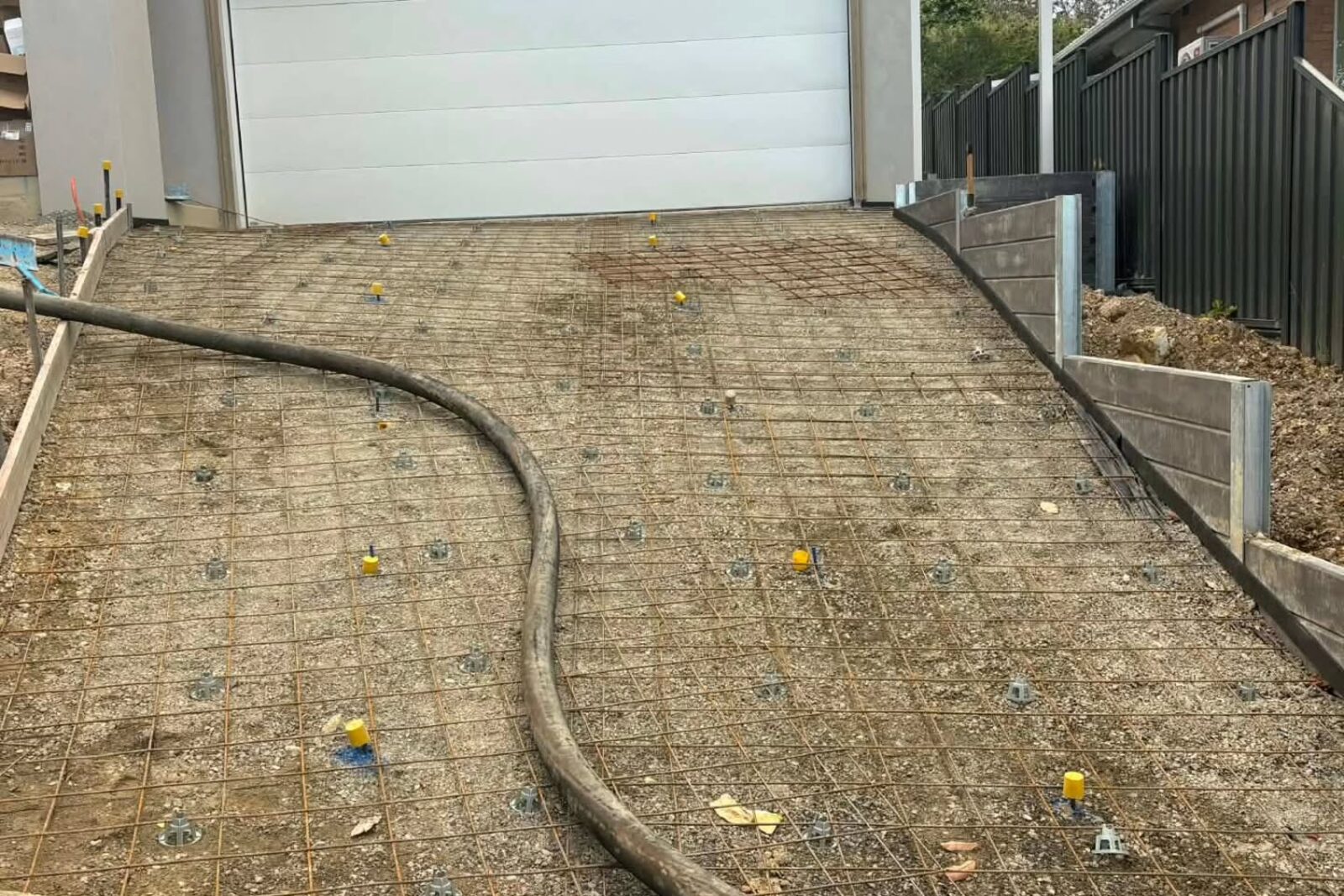
Steel reinforcing mesh laid over a driveway before the concrete pour

The short version

  • Reinforcing mesh is specified by the job — lighter mesh for paths, heavier for shed and house slabs.
  • Mesh is sold in grades (e.g. SL72, SL82, F-series) that describe bar size and spacing.
  • Placement and cover matter as much as the mesh — it must sit in the slab on chairs, not on the ground.
  • For structural slabs, follow the engineer's spec.

Reinforcing mesh is what stops a slab cracking apart under load and movement — but only if you use the right grade and, just as importantly, place it correctly. Here's how mesh sizing works and what tends to suit common jobs, with the usual caveat that structural slabs follow the design.

How mesh sizing works

Reinforcing mesh comes in standard grades that describe the bar diameter and spacing — you'll see codes like SL72, SL82 and the F-series (F72, F82 and so on). A higher number generally means thicker bars and more steel, so more reinforcement. The grade you need depends on the slab's job and the design.

What tends to suit which slab

  • Paths & light slabs — lighter mesh is often enough.
  • Shed & domestic slabs — commonly a heavier reinforcing mesh, per the design.
  • House & structural slabs — specified by an engineer, sometimes with additional bar and beams.

Because reinforcement is a structural choice, treat these as context, not instruction — your plans or engineer set the actual grade.

Placement matters as much as the grade

The best mesh does nothing lying on the ground. It has to sit at the correct height in the slab, held up on bar chairs, with proper cover of concrete around it so it doesn't rust or sit exposed. Lap and tie sheets correctly, and keep it clean. Get placement wrong and even the right mesh won't protect the slab.

Slab prepped and ready to pour? We'll pump it cleanly around your steel, and can supply the concrete too. Get a quote →

Mesh, thickness and mix work together

Reinforcement is one leg of a strong slab — the others are the right thickness and mix strength, on a well-prepared base. Plan all of them together and size your concrete order with the calculator.

CGI Concrete Pump Melbourne
Written by CJ Iordanou
Co-owner & pump operator, CGI Concrete Pump Melbourne

CJ is one of the two brothers behind CGI Concrete Pump Melbourne. He's spent 15 years in concrete — on the tools laying it and now running the pumps — so these guides come from real Melbourne job sites, not a textbook.

Connect with CJ Iordanou on LinkedIn
Published 31 July 2026
Prepping Steel Mesh & Formwork Before the Pour
FAQ

Quick answers

What mesh do I use for a shed or house slab?
Reinforcing mesh is specified by the job. Lighter mesh can suit paths and small slabs, while shed and house slabs commonly use heavier reinforcing set by the design or engineer. Because it's a structural choice, follow your plans rather than a rule of thumb.
Does mesh placement matter?
A lot. Mesh only does its job if it sits in the right part of the slab with correct cover, held up on bar chairs — not lying on the ground. Good placement is as important as picking the right mesh.
Concrete pump hire FAQ

More questions about concrete pumping

Which parts of Melbourne and Victoria do you cover?
We hire concrete pumps right across metropolitan Melbourne and out into regional Victoria — including the Mornington Peninsula, Geelong, the Yarra Valley and the outer growth corridors. If you're not sure we reach your site, call us on 0412 845 415.
Can you supply the concrete as well as the pump?
Yes. We can arrange ready-mix supply and delivery alongside the pump so you deal with one team for the whole pour. See our concrete delivery page or ask for a combined quote.
How far ahead should I book a concrete pump?
For most residential jobs a few days' notice secures your preferred date; busy periods and larger commercial pours book out further ahead. The sooner you lock in the date the better — get in touch to check availability.
Do I need a line pump or a boom pump?
It depends on access and pour height. Line pumps suit tight residential sites and ground-level work; boom pumps reach over buildings and into hard-to-access areas. Our line pump vs boom pump guide breaks it down, or we can advise on a quick call.
What should I have ready on site before the pour?
Clear access for the truck, a water source for washout, formwork set and signed off, and enough crew to place and finish. We'll walk you through site setup when you book — see our hire rates for what's included.

Fast quotes · Melbourne & Victoria wide

Book a concrete pump that turns up on time

Tell us the site, the pour and the date. We'll come back with a straight price and a clean, reliable pump crew — line pump or boom, resi or commercial.

📍 Based Kilsyth South VIC — serving all of Melbourne & Victoria
✉
GET A QUOTE — 30 SECONDS